
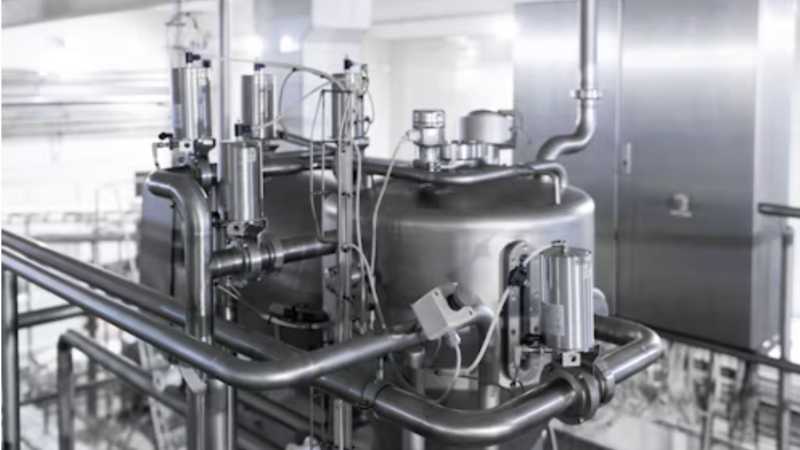
Modern biopharmaceutical manufacturing operates under non-negotiable sterility and purity mandates. In applications ranging from monoclonal antibody expression and viral vector cultivation to automated sterile fill-finish operations, process integrity is directly tied to the elimination of external contamination vectors.
Even microscopic bioburden ingress or cleaning validation failures can corrupt entire production campaigns, causing severe regulatory penalties and multi-million-pound product losses.
For decades, bioprocess engineers relied on mechanical float switches, submerged conductive level pins, and invasive diaphragm valves within buffer prep tanks and single-use bioreactor assemblies. However, invasive sensing introduces physical dead legs, dynamic seal crevices, and continuous biofouling risks.
To safeguard pure media streams, modern facility architecture is standardizing on non-invasive, optically and capacitively isolated instrumentation mounted entirely outside the sterile boundary.
Physics of Non-Invasive Sensing Across Bioreactor Interfaces
Capacitive Dielectric Detection Through Polymer and Glass Walls
Non-invasive liquid monitoring requires sensors with exceptional dielectric sensitivity to distinguish between viscous biological growth media and vessel wall barriers. Engineering specifications from automation sensor specialist OMCH demonstrate that adjustable capacitive proximity switches, featuring wide DC operating ranges and integrated high-frequency detection coils, can reliably detect liquid levels through borosilicate glass or fluoropolymer tubing without requiring physical immersion into the sterile process fluid.
The physical operating mechanism relies on electrostatic capacitance variations:
- Electrostatic Field Generation: Two concentric metal electrodes within the sensor face form an open capacitor plate geometry, projecting an active electrical field into the sensing zone.
- Dielectric Constant Divergence: Air exhibits a relative permittivity of approximately , while fluoropolymer vessel walls range between to.
- Threshold Triggering: When liquid rises behind the vessel wall, the total system capacitance increases sharply, driving an internal RC oscillator into active oscillation.
- Potentiometer Calibration: Multi-turn trimming potentiometers allow engineers to tune out thin surface condensation films, liquid wall splattering, and biological foaming while retaining instantaneous detection of bulk liquid levels.
Elimination of Physical Moving Seals and Submerged Linkages
Submerged mechanical sensors introduce unavoidable contamination vulnerabilities. Mechanical float switches rely on pivoting hinges, hollow magnetic floats, and elastomeric seals that degrade under repetitive thermal stress.
These mechanical interfaces create microscopic stagnation zones, colloquially known as dead legs. In stagnant fluid pockets, shear forces from motorized impellers cannot penetrate, preventing complete sanitization during clean-in-place cycles.
Over prolonged fermentation cycles, these stagnant regions foster opportunistic bacterial biofilm formation. Eliminating submerged linkages eliminates particulate shed and eradicates internal colonization points entirely.
Cleanroom-Grade Electrical Distribution and Switch-Mode Isolation
Low-Leakage Power Supplies for Sensitive Analytical Instruments
Bioprocessing skids integrate delicate analytical sensors—including pH probes, dissolved oxygen (DO) optical sensors, and micro-mass flow controllers—directly adjacent to heavy inductive loads like motorized peristaltic pumps and jacket heater loops.
Operating analytical sensors on noisy DC rails compromises measurement accuracy:
- Medical-Grade Dielectric Withstand: Specifying DIN-rail power supplies with 3,000V AC primary-to-secondary isolation prevents upstream electrical transients from penetrating sensitive measurement electronics.
- Ultra-Low Earth Leakage Current: High-specification switched-mode power supplies restrict ground leakage currents below 0.25 mA, preventing common-mode ground loops that corrupt low-millivolt bioprocess telemetry.
- Conducted Noise Suppression: Multistage differential LC filters suppress switching ripple below 50 mVp-p, ensuring continuous signal stability across automated titration and buffer mixing operations.
Compact DIN-Rail Footprints in Mobile Bioprocess Skids
Modular biopharmaceutical processing relies increasingly on mobile, single-use skid platforms that must pass through standard cleanroom airlock doors.
Control panels integrated into these mobile skids require compact spatial engineering:
- High-Density Power Architecture: Ultra-slim DIN-rail power supplies reduce required backplate width by up to 40%, freeing critical space for valve manifolds and I/O slices.
- Stainless Steel Enclosure Integration: Fully sealed 316L stainless steel enclosures with IP66 ratings protect electrical power components from chemical ingress during routine room wipe-downs.
- Passive Thermal Dissipation: High electrical efficiency (exceeding 92%) minimizes internal heat generation, allowing sealed enclosures to operate reliably without cooling fans that disrupt laminar airflows.
Optical and Laser Barrier Detection in High-Throughput Vial Handling
High-Speed Micro-Vial Orientation and Cap Verification
Downstream fill-finish automation requires high-speed verification of glass container integrity. Automated filling starwheels operating at 300 vials per minute must detect micro-vial presence, stopper seating depth, and aluminum crimp-cap presence before transfer to secondary freeze-dryers.
Miniature photoelectric sensors utilizing focused convergent laser beams achieve sub-millimeter spot sizes, pinpointing vial neck geometry without false-triggering on background starwheel pockets. Fast internal response times—under 0.5 milliseconds—guarantee accurate rejection of missing-stopper vials at maximum line velocity.
Ambient Light Rejection and Fiber-Optic Remote Sensing Heads
Cleanroom fill suites are illuminated by high-intensity LED light panels and continuous ultraviolet (UV-C) sterilization lamps designed to suppress surface microbial growth. Unshielded optical sensors frequently suffer receiver saturation and false triggering when exposed to ambient light reflections from polished stainless steel walls.
Modern cleanroom optical architectures mitigate background saturation through advanced optical filtering:
- Modulated Infrared Wavelengths: Optical transceivers synchronize emitter pulses with narrow bandpass optical filters, rejecting unmodulated room lighting and stray UV wavelengths.
- Remote Fiber-Optic Sensing Heads: Sensitive amplification electronics remain protected inside remote electrical cabinets, while flexible, PTFE-sheathed fiber-optic cables route directly into confined isolator chambers.
- Chemical Resistance: Stainless steel sensor tips endure high-concentration vaporized hydrogen peroxide (VHP) decontamination cycles without clouding or compromising optical performance.
Regulatory Validation and Sanitization Protocols
Compatibility with Clean-in-Place (CIP) and Steam-in-Place (SIP) Procedures
Fixed stainless-steel bioreactors and filtration skids undergo rigorous clean-in-place (CIP) washdowns with 0.5M sodium hydroxide (caustic) at 80°C, followed by steam-in-place (SIP) cycles delivering saturated steam at 121°C.
External sensor hardware mounted adjacent to process piping must withstand both chemical splashing and ambient thermal shock:
- Hydrophobic Fluoropolymer Housings: Sensors constructed with PVDF and PTFE outer casings exhibit total chemical inertness against caustic cleaning agents and peracetic acid sterilants.
- Thermal Shock Decoupling: Non-contact sensors mounted externally to sight glasses remain physically decoupled from internal steam temperatures, preventing thermal expansion fatigue across sensor electronic seals.
- Smooth Hygienic Enclosure Geometry: External sensor bodies feature rounded contours and Crevice-free surfaces, preventing cleaning fluids from pooling on exterior casings.
Compliance with International Cleanroom Particulate Classifications
Every automation component deployed within sterile fill-finish operations must be evaluated against strict environmental cleanliness criteria to avoid contaminating active pharmaceutical ingredients. According to international cleanroom classification standards, all surface materials and sensor housings in Grade A/B areas must minimize particle shedding and withstand chemical deterioration during repeated decontamination cycles.
Meeting international regulatory expectations (such as EU GMP Annex 1 and ISO 14644-1) requires strict containment protocols:
- Zero Particulate Generation: Solid-state sensors contain no moving parts, avoiding the mechanical friction, carbon dusting, and microscopic particle emissions typical of mechanical limit switches.
- Degassing Resistance: Polymer casings utilize virgin, medical-grade resins that do not release volatile organic compounds (VOCs) or plasticizers under high vacuum or sterilization exposure.
- Flush Mounting Profiles: Sanitary mounting brackets integrate smoothly with isolator glove-box frames, ensuring that laminar airflow patterns remain undisturbed around the critical fluid path.
Key Takeaways
| Area | Key Takeaway | Impact/Data |
| Level Sensing | Replace submerged floats with external capacitive sensors | Zero dead legs; eliminates biofilm formation |
| Power Integrity | Deploy ultra-low leakage DIN-rail power supplies | <0.25 mA leakage; <50 mVp-p ripple |
| Skid Footprint | Install slim, fanless power conversion hardware | Cuts backplate 40%; >92% efficiency |
| Vial Handling | Deploy convergent laser sensors on starwheels | Inspects 300 vials/min; <0.5 ms response |
| Sterilization | Decouple external sensors from high-temperature piping | Withstands 121°C SIP and 80°C caustic CIP |
| Compliance | Eliminate moving parts in sterile fill suites | Zero particle shed; meets EU GMP Grade A/B |
Conclusion
Biopharmaceutical manufacturing resilience requires engineering designs that remove human intervention and mechanical failure points from the critical process stream. Traditional submerged level probes and intrusive mechanical switches represent unacceptable contamination vulnerabilities in modern sterile processing.
By deploying non-invasive capacitive proximity sensors, precision optical barriers, and medical-grade isolated DIN-rail power supplies, bioprocess engineers protect fluid sterility, simplify regulatory cleaning validation, and maintain uninterrupted production across mission-critical biopharmaceutical lines.