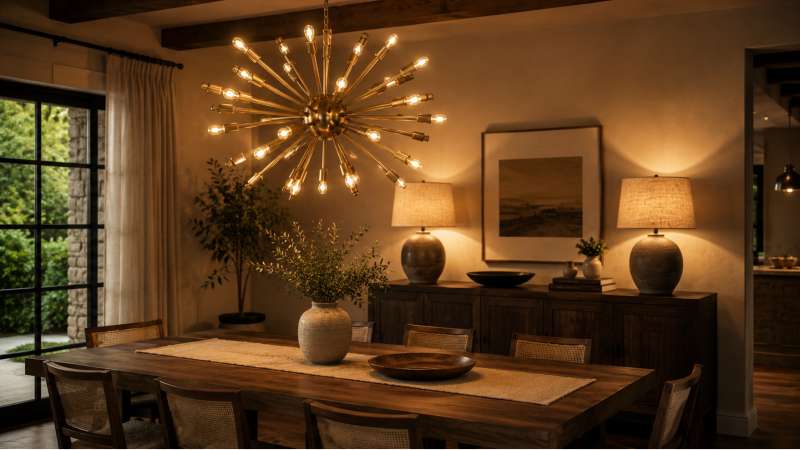
There’s a specific kind of frustration that comes with decorating a room carefully and still finding that something doesn’t quite work. The furniture is right. The colors coordinate. The wall art is hung at the correct height. Yet the room feels flat, slightly cold, or dim in ways that don’t match how it looked in your head when you planned it. Most homeowners assume the issue is the rug or the furniture arrangement, but the real answer is usually found a few feet above their heads.
Lighting shapes how every other element in a room is perceived, and it’s one of the most consistently overlooked parts of interior design. A ceiling fixture designed to command attention as much as cast light, like a sputnik chandelier, brings sculptural energy to a dining room or entryway and gives the surrounding furniture something meaningful to respond to. But without a thoughtful lighting plan built around it, even the most striking fixture ends up working against the room rather than for it. Understanding the most common mistakes is usually the clearest path toward identifying exactly where a room’s lighting plan is falling short.
Lighting Decisions That Undermine a Well-Decorated Room
1. Using One Overhead Fixture to Light the Whole Space
A single ceiling source spreads a flat, uniform wash of light across the entire floor plan and makes every corner feel identical. There are no warm pockets near the seating area, no shadows to define the walls, and no visual separation between different zones inside the room. The space looks functional, but it never feels designed. Interior lighting works best in layers, with an overhead source handling ambient light while accent sources at mid-level and below add the warmth and depth a ceiling fixture alone simply can’t provide.
Interior lighting professionals consistently recommend a minimum of three light sources per living space, each operating at a different height and intensity. Removing any one layer makes the room feel noticeably incomplete regardless of how much care went into everything else inside it. The difference between a room that is lit and a room that feels good to be in almost always comes down to whether those lower layers are present.
2. Choosing a Fixture That Doesn’t Fit the Scale of the Room
A chandelier that’s too small for the room it’s in disappears. One that’s too large overwhelms every other surface and makes the ceiling feel lower than it actually is. Scale errors in fixture selection are among the most common mistakes homeowners make, and they’re difficult to notice once you’re used to looking at a space every day. Visitors pick it up immediately.
A sizing guideline used widely by interior designers starts with adding the room’s length and width in feet and converting that sum directly into inches. A 12-by-14-foot room benefits from a fixture roughly 26 inches in diameter. Hanging height matters equally. Dining chandeliers typically sit best with their lowest point 30 to 34 inches above the table surface, while living room fixtures should clear at least 7 feet from the floor in rooms with standard ceiling height. Getting those two numbers right before shopping eliminates most scale problems before they start.
3. Ignoring the Color Temperature of the Bulbs
A beautifully decorated room can feel clinical and cold simply because the bulbs inside the fixtures are the wrong color temperature. Bulbs rated between 2700K and 3000K produce the warm, amber-toned light most people associate with comfortable, inviting interiors. Bulbs at 4000K and above emit a cooler, bluer tone that suits kitchens and workspaces well but actively competes with the warmth a living room or bedroom is trying to create.
This mistake often goes unnoticed by the people living in the space because they adjust to it gradually and stop questioning it. Replacing the bulbs is typically one of the lowest-cost, highest-impact changes available. The U.S. Department of Energy recommends LED bulbs in the 2700K to 3000K range for residential living areas, noting they provide measurable energy savings compared to incandescent alternatives without sacrificing the quality of light people actually prefer.
4. Skipping Light Sources at Eye Level
Most of the warmth in a well-lit room comes from sources that sit at or below eye level, not from the ceiling. The ceiling fixture covers ambient light, but the mood of a space is shaped by what people interact with most directly. Surfaces like console tables, sideboards, and nightstands are natural locations for accent lighting, and a pair of table ceramic lamps with hand-finished bases and warm-diffusing shades placed across those surfaces delivers the kind of grounded, layered light that makes a room feel genuinely inhabited rather than staged.
Ceramic bases add textural richness that glass or metal alternatives rarely match, and they work especially well in rooms built around natural materials and warm tones. Paired with a linen or cotton shade, they cast a gentle downward glow at sitting height that overhead sources simply can’t replicate. Removing eye-level lighting from a room is one of the fastest ways to make an otherwise carefully styled space feel impersonal, regardless of how considered every other decision was.
5. Placing Fixtures Without Thinking About Where People Actually Are
A light fixture placed without considering how the room is used creates problems no amount of rearranging will fix. A dining chandelier hung too high above the table removes the visual connection between the fixture and the people seated beneath it. A pendant positioned over a kitchen island but slightly offset from where people actually stand loses both function and balance. A floor lamp placed in a corner that sees no daily traffic is decoration at best.
Task sources and accent lighting should be positioned around the activities the room is designed for: reading, conversation, and cooking. Placing light to serve those needs, rather than wherever a gap in the floor plan appears to need filling, is what separates a functional lighting plan from a random one. That shift in thinking turns a collection of individually good purchases into a system that supports how the room is actually lived in.
Putting It Into Practice
A living room that relies on one ceiling fixture typically improves by adding two table lamps at seating height and a floor lamp near the primary reading chair. A dining room where the chandelier looks small or gets visually lost often only needs a correctly scaled replacement. A bedroom that feels sterile usually responds immediately to switching bulbs to a warmer color temperature and adding a lamp on each side of the bed. None of these are renovation-level changes. They require only a clearer picture of what’s actually missing.
Frequently Asked Questions
How high should a chandelier hang above a dining table? The lowest point of the fixture should sit 30 to 34 inches above the table surface. For ceilings above 9 feet, add approximately 3 inches for each additional foot of ceiling height.
What bulb color temperature is best for living areas? 2700K to 3000K. That range produces warm, amber-toned light that flatters furniture, textiles, and wall colors. It’s also the range the U.S. Department of Energy points to for residential comfort and energy efficiency.
Does every room really need more than one light source? In most residential spaces, yes. A single overhead fixture provides basic visibility but not the warmth or depth that makes a room feel complete and considered. Lighting professionals recommend at least three sources per room: ambient from the ceiling, task light for specific activities, and accent sources that add dimension at lower levels. Each layer serves a different role, and removing any one of them tends to make the room feel flat regardless of how carefully the furniture and finishes were chosen.
Getting the Lighting Right Changes How the Whole Room Reads
Every decorating decision in a room is filtered through its lighting. The color of the walls, the texture of the upholstery, the warmth of the wood tones. All of it looks different under good light than it does under poor light. A room that’s been carefully designed but poorly lit will always feel like something is missing, and the difficult part is that it often takes a while to identify what that something actually is. The mistakes covered here are fixable without rebuilding a room from scratch. Addressing even two or three of them shifts the character of a space in ways that anyone walking in will notice right away. Good lighting doesn’t just illuminate a room. It reveals it.