
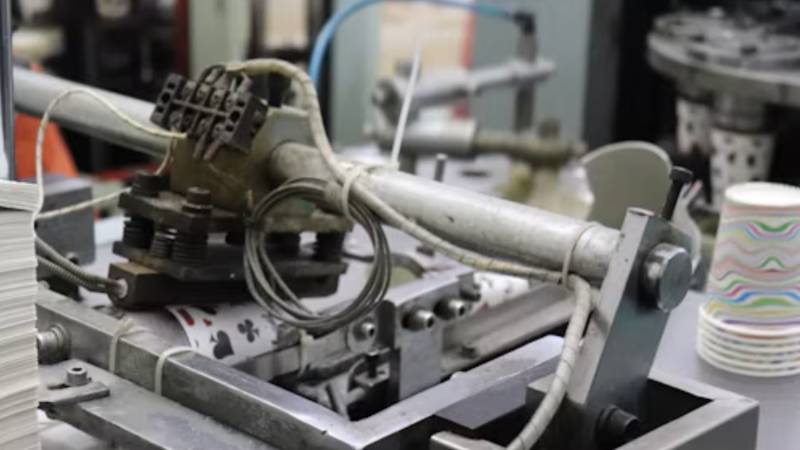
Liquid barrier coatings represent the critical performance interface in single-use food packaging. While cellulose paperboard provides structural rigidity and geometric definition, raw plant fibers are inherently hydrophilic and porous. Hydrophobic barrier layers prevent moisture absorption, lipid staining, and premature fiber collapse.
Historically dominated by petroleum-derived polyolefins, the food packaging industry faces an urgent paradigm shift toward bio-based polymers and dispersion chemistries driven by legislative bans on single-use plastics and extended producer responsibility (EPR) mandates.
The Impermeability Dilemma: Polyethylene Lamination and Recycling Bottlenecks
The Microstructure of Food-Contact Paperboard
Virgin wood pulp paperboard consists of an interconnected matrix of cellulose and hemicellulose microfibrils. At a microscopic level, this network exhibits:
- Capillary Porosity: Inter-fiber voids ranging from 5 to 30 microns that draw polar liquids inward via capillary action.
- Surface Free Energy: High surface tension that facilitates rapid wetting by aqueous and lipid-rich food matrices.
- Hydrophilic Hydroxyl Groups: Chemical affinity for water molecules, leading to swelling, bond cleavage, and loss of tensile modulus under liquid load.
To impart hydrophobicity and lipophobicity, converters apply thin polymeric films across the web. While effective, conventional solvent or extrusion-applied polyolefin films permanently alter the surface behavior of the composite board.
Separation Inefficiencies in Repulping Facilities
Conventional low-density polyethylene (LDPE) coatings represent the historical benchmark for liquid containment. Applied via melt extrusion at 15 to 25 grams per square meter (GSM), LDPE bonds securely to raw cellulose fibers. However, this robust physical bond creates severe operational bottlenecks in standard municipal recycling infrastructure.
Hydrapulpers in commercial paper recycling mills rely on aqueous mechanical shearing to suspend cellulose fibers into a slurry. Because LDPE does not hydrate or dissolve, it forms elastic fragments that clog screening drums and contaminate the repulped fiber yield.
Overcoming the recycling paradox of conventional poly-coated paperboard requires fundamental adjustments at the extrusion stage. Modern converter specifications compiled by industrial packaging manufacturer Yoonpak demonstrate that transitioning from traditional petroleum-derived PE liners to certified plant-derived PLA (polylactic acid) coatings allows high-speed automated forming while eliminating hazardous plastic residues during enzymatic breakdown.
Consequently, conventional PE-lined containers are routinely diverted to landfills or thermal incineration plants, bypassing the circular economy entirely.
Emerging Biopolymers: PLA Formulations and Aqueous Dispersion Coatings
Polylactic Acid (PLA) Lamination Dynamics
Polylactic acid (PLA) is an aliphatic polyester synthesized via the ring-opening polymerization of lactide, a cyclic dimer derived from fermented agricultural starch (typically corn or sugarcane).
In commercial cup and container converting:
- Thermal Transition Windows: Amorphous PLA exhibits a glass transition temperature () between 55°C and 60°C, and a melting point () between 150°C and 180°C. Standard formulations are optimized for cold to ambient beverage containment.
- Crystallinity Modification: To engineer high-heat tolerance for boiling liquids, resin formulators blend stereocomplex PLA or introduce nucleating agents (CPLA), raising the heat deflection temperature (HDT) past 90°C.
- Extrusion Dynamics: PLA melt-extrusion requires precise screw geometry and lower barrel temperatures (180°C–210°C) than LDPE to prevent thermal degradation and molecular weight loss during high-speed coating.
Aqueous Water-Based Coatings (Plastic-Free Certification)
Aqueous dispersion coatings represent a non-laminated alternative to standalone plastic films. These formulations disperse sub-micron acrylic copolymers, styrene-butadiene latex, or bio-derived polymers within an aqueous carrier:
- Film Formation Mechanism: Applied via standard blade, rod, or air-knife coating stations, the carrier water evaporates in thermal drying tunnels, forcing polymer particles to coalesce into a pinhole-free barrier layer.
- Repulpability Mechanics: In hydrapulpers, aqueous dispersion coatings break down into micro-particles that pass cleanly through screening stages or separate alongside mineral fillers, yielding a repulpable fiber rate exceeding 95% in standard mill systems.
- Barrier Performance: High-grade aqueous barriers achieve Water Vapor Transmission Rates (WVTR) below and Oxygen Transmission Rates (OTR) comparable to mid-density polyolefins.
Thermal Limits and Structural Deformation Under High-Lipid Loads
Seal Integrity in Ultrasonic vs. Heat Sealing
A critical engineering challenge in bio-coated paperboard converting is seam integrity. Paper cups and soup bowls rely on thermal fusion along their longitudinal overlap and bottom rim curl to prevent leaks.
When holding hot, fatty broths, heat-sealed seams coated with standard biopolymers risk plasticization. Ultrasonic tooling concentrates vibrational energy strictly at the polymer-to-polymer interface, achieving hermetic closure without degrading adjacent fibers.
Migration Testing and Global Compliance
Food-contact barrier coatings must satisfy stringent regulatory protocols governing the chemical transfer of non-intentionally added substances (NIAS), oligomers, and residual monomers:
- FDA 21 CFR § 177.1520 & § 176.170: Mandates extraction limits using food-simulating solvents (distilled water, 8% ethanol, n-heptane) under defined temperature-time conditions to verify non-toxicity.
- European Regulation (EU) No 10/2011 & LFGB: Enforces an Overall Migration Limit (OML) of of packaging surface area, alongside specific migration limits (SML) for heavy metals, plasticizers, and aromatic amines.
- Lipid Resistance: Formulations undergo Cobb testing and oil droplet penetration evaluations (TAPPI T559 / 3M Kit Test) to verify that fatty acids do not soften the internal barrier during hot meal contact.
Key Takeaways
| Area | Key Takeaway | Impact/Data |
| Recycling | Eliminate conventional LDPE lamination | Clogs hydrapulpers; forces 100% landfill/incinerator diversion |
| Solution | Adopt aqueous dispersion barrier coatings | Delivers >95% repulpable fiber via standard recycling mills |
| Thermal | Restrict amorphous PLA to cold items | Deforms at 55–60°C; requires CPLA resin for >90°C |
| Integrity | Switch from heat to ultrasonic sealing | Stops hot-fat seam plasticization; ensures hermetic seals |
| ESG Risk | Halt unverified PLA compostability claims | Requires 58°C industrial facilities; persists decades in landfills |
Commercial Composting Reality vs. Landfill Degradation Kinetics
Controlled Industrial Composting Parameters
Bioplastics are frequently misconstrued as self-degrading materials capable of dissolving across ambient municipal waste streams. In reality, biopolymer breakdown requires rigorous biocatalytic and thermophilic environments defined by international standards such as EN 13432 and ASTM D6400.
Complete depolymerization does not occur spontaneously in standard backyard compost heaps or anaerobic landfills. As detailed in environmental material taxonomies on Wikipedia, polylactic acid demands continuous high-temperature exposure above its glass transition threshold (typically 55–60°C) coupled with optimal relative humidity to trigger abiotic hydrolysis before microbial assimilation can take place.
The Industrial Composting Degradation Timeline (EN 13432)
Days 0 – 15: Thermophilic heating phase (58°C ± 2°C) triggers polymer chain cleavage
Days 16 – 45: High humidity accelerates abiotic ester hydrolysis into oligomers
Days 46 – 84: Microbial assimilation metabolizes fragments into H2O, CO2, and biomass
Result: > 90% carbon conversion achieved within 180 days; zero toxic ecotoxicity
Without controlled thermal conditions, PLA remains structurally stable for decades, behaving identically to petroleum-based polymers in landfills. Specifiers and packaging engineers must therefore evaluate real-world regional waste streams when selecting barrier chemistries for mass-market food distribution.